bangladesh
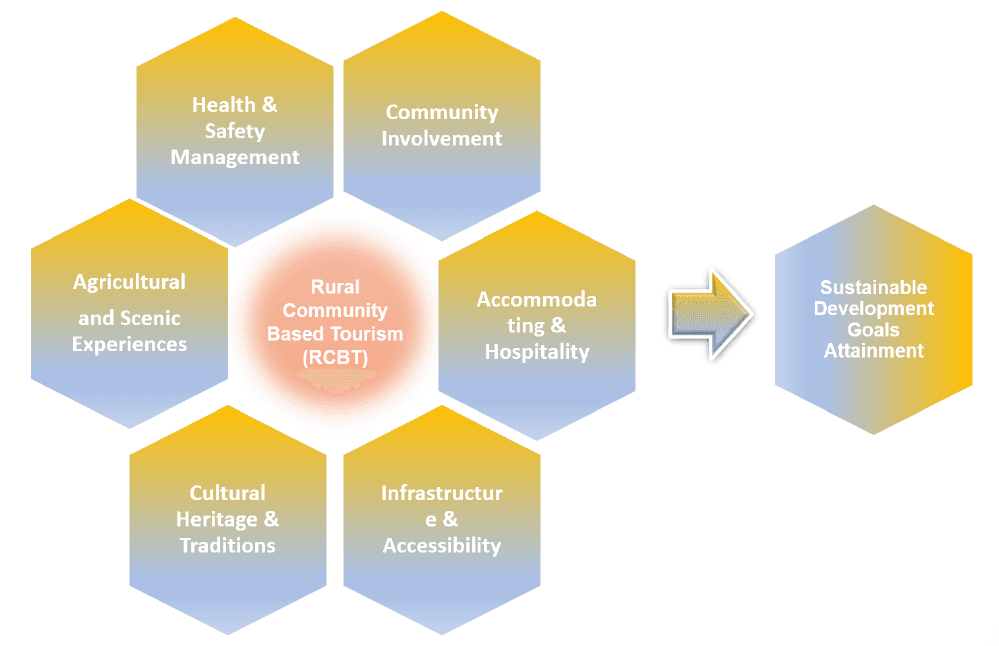
The aim of the research paper is to investigate the association between the Rural Community-Based Tourism (RCBT) exploration and sustainable Development Goals (SDGs) attainment. The rural community-based tourism has gained much attention in present conditions to meet the sustainable development goals in many countries. This descriptive research demonstrated the contribution of rural community-based tourism for developing and implementing strategies and policies to promote SDGs and also sought the forces, opportunities and challenges for achieving SDGs associated with rural community-based tourism in Bangladesh. There are many historical heritage sites with a diverse range of cultures, traditions, and natural resources in Bangladesh. The proposed model could be used in many studies that analyze different variables of rural community-based tourism that influence in promoting sustainable development goals. The results of the study demonstrated that many activities like poverty, hunger, good health & wellbeing, gender equality, clean water & sanitation, decent work, economic growth, sustainable cities & communities, responsible consumption & production, climate action, life below water, life on land can be integrated with rural community-based tourism to attain the SDGs in Bangladesh. The empirical model also identifies the components of rural community-based tourism that will be able to continue the progress in implementing the SDGs in the right way as well. The overall results will show the rural community-based tourism as a favorable tool that can contribute to promote sustainable development goals in Bangladesh.
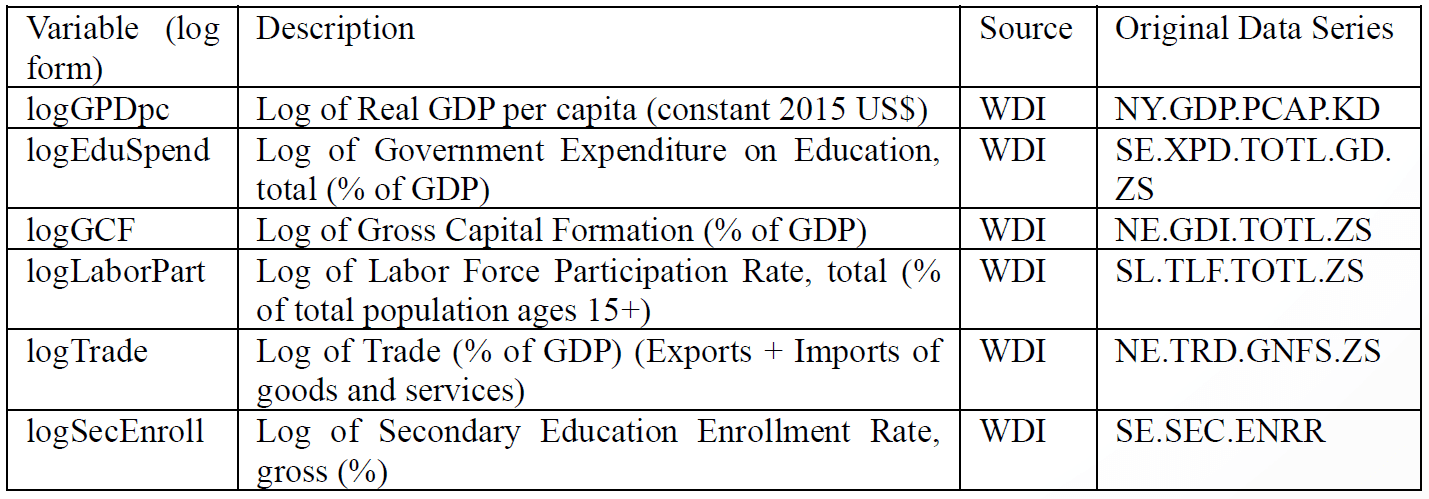
This study examines how education expenditure influences Bangladesh's economic growth in the long-run. It fills a policy research gap regarding human capital investment's effectiveness, but the study tests whether the chosen macroeconomic variables would be I(0) and I(1) to show long-run stable, cointegrating relationships. Unit root tests [Augmented Dickey-Fuller (ADF) test and KPSS] were conducted on time-series data from 1998-2024, showing a mixed order of integration, where variables are I(0) and I(1). Thus, Autoregressive Distributed Lag (ARDL) Bounds Testing for cointegration is appropriate. ARDL is an appropriate test for mixed orders of integration and smaller sample sizes. The null hypothesis of long-run cointegration is confirmed at the .05 level by the F-statistic value of 10.52 (greater than the critical bounds value). Furthermore, the elasticity derived from education expenditure is statistically significant across all models at almost 0.99, which means that when education expenditure increases by one percent, GDP per capita increases by one percent in the long-run. Furthermore, a statistically significant Error Correction Term (ECT) value of −0.048 confirms that the error term is sustainable, meaning the economy corrects for 4.8 percent of its disparity every year. Therefore, these results provide extensive empirical support for the long-run approach of increased education expenditure as a valid approach to Bangladesh's economic growth in the future. This increases the likelihood that policymakers may want to move forward with increased education efforts to both level up and increase quality and quantity for best results.