nusrat-jahan
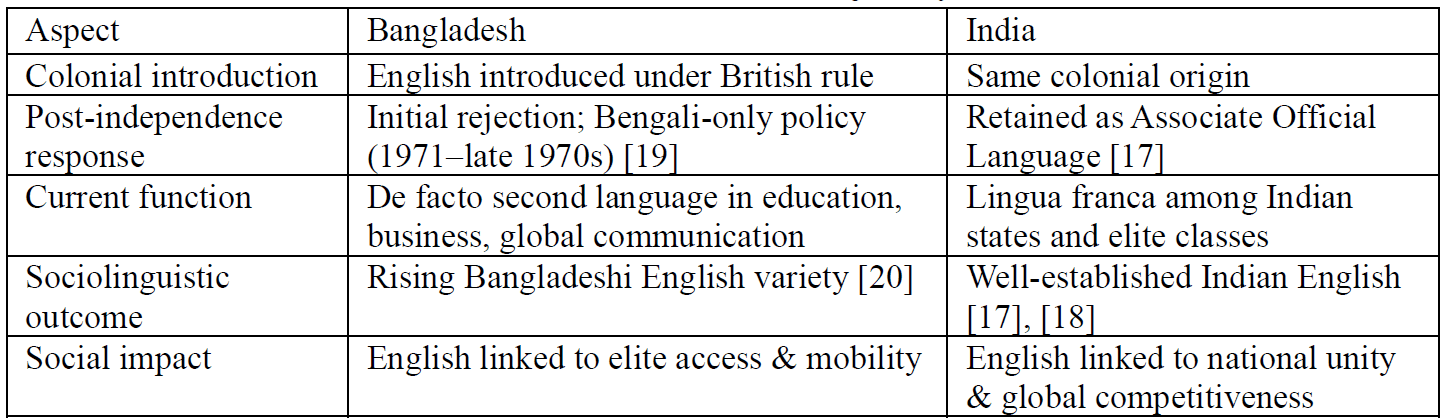
This paper examines transnational movement of English in Bangladesh and India. It contrasts history, rules of language and the way people use language nowadays. The study is based on existing scholarly articles, policy documents, and international reports. They adopted a qualitative, inductive approach in tracking how the English had been introduced by the British, and how its positioning has modified after independence. The findings indicate that India retained English as an official language alongside other languages. This assists India in managing numerous languages and ensures smooth running of government and universities in India. In contrast, Bangladesh initially rejected English and opted to use Bangla to demonstrate national identity. It later reintroduced English due to pragmatic, universal and monetary causes. Although their personalities differ, in both countries, English has become the center to education, employment, and global communication. Nevertheless, not all people receive good education in English. This social inequality sustains societal inequalities. The research highlights the need for equitable multilingual policies. Besides, the proposed study is theoretically informed by Bourdieu concept of linguistic capital in which English is viewed as a socially valued resource that is not equally distributed among populations. After all, they must promote national languages and provide equal opportunity to all people to study English to have a fair future.